
Reinforcement Learning for Business teaches the essentials of business optimization using reinforcement learning and AI models through relevant and useful business applications.
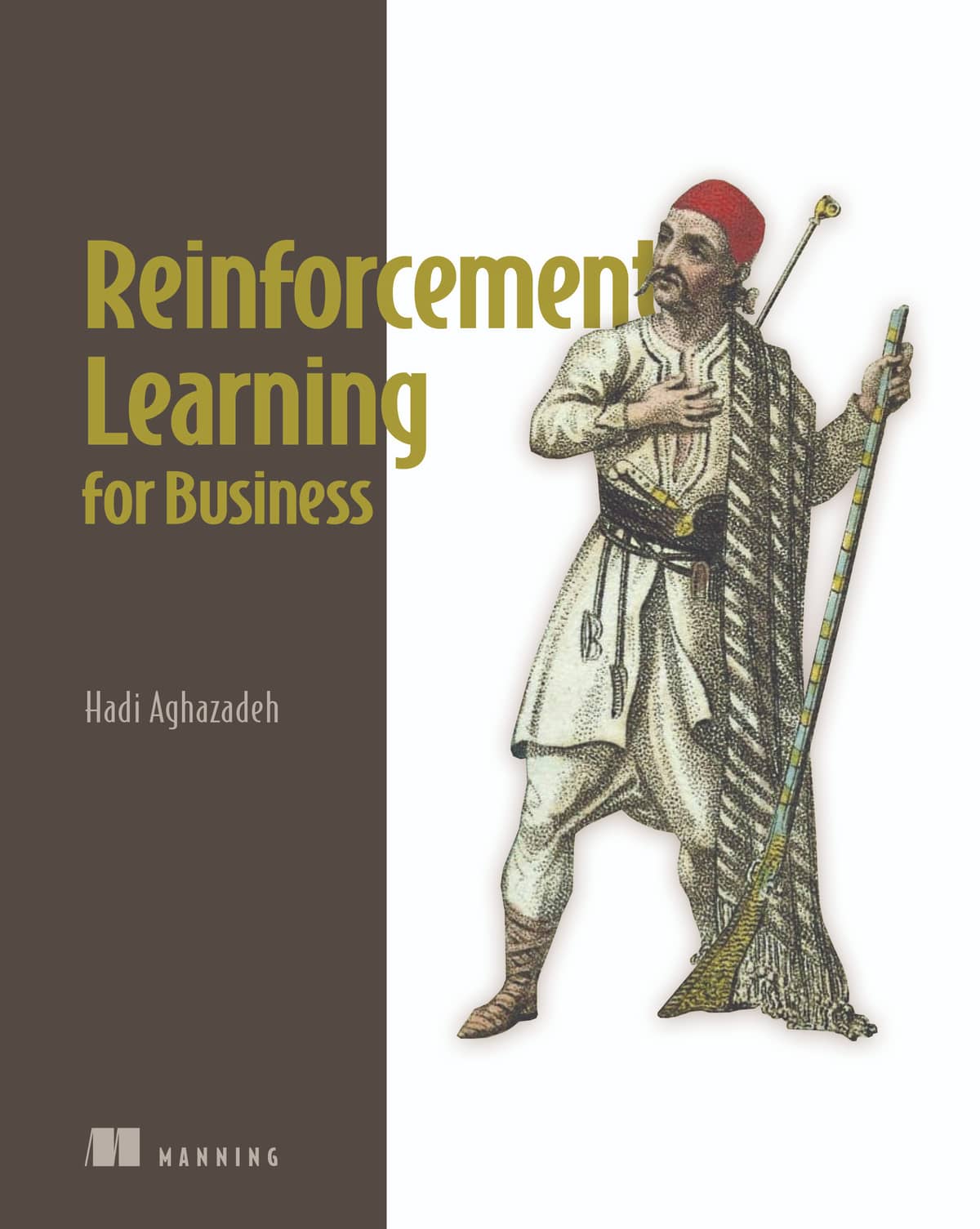
Hadi Aghazadeh
 What’s in the book
Here’s what you’ll get from this book, especially if you’re interested in applying RL beyond toy problems:
-
Real-world business cases: delivery routing, scheduling, dynamic pricing, ad campaign optimization, supply chain improvements.
-
A spectrum of RL algorithms — contextual bandits, tabular methods, Deep Q-Networks (DQN), actor-critic methods, plus stuff like Deep Deterministic Policy Gradient (DDPG) for continuous/action spaces.
-
How to build and use custom simulation environments to train RL agents safely & effectively for business settings.
-
Integrating RL with newer AI techniques, for example RL with Human Feedback (RLHF) to better align agents with business constraints and goals.
 Who it’s built for
If you’re wondering whether this is for you, here are the reader requirements / ideal audience:
-
Comfortable with programming at an intermediate level (Python / ML comfort is assumed).
-
Familiar with business process thinking: logistics, pricing, operations, ad targeting — this isn’t purely theoretical; it leans heavily into how to solve real business optimization problems.
-
You don’t need to be a Ph.D. in reinforcement learning, but you should be ready to dive into algorithms and trade-offs. The math isn’t extremely deep, but you’ll want to understand the basics.
 Why it might matter to you
Here are some reasons I think this title could be a solid addition to your shelf:
-
From research to production: Lots of RL material out there is proof-of-concept or research-focused. This book bridges to business value: deployment, constraints, costs, sim environments.
-
Agentic and dynamic business landscapes: Businesses today need to adapt fast—dynamic pricing, changing demand, and supply chain disruptions. RL gives a framework for policies that adapt, not just static rules.
-
Helpful for ML/AI teams looking to do more than “just predictions”: If you have forecasting, classification, etc., and you want to move toward decision-making systems that optimize over time (cost vs benefit tradeoffs, reward functions, constraints), this can help you make that leap.
-
Good pedagogical style: case studies, code, math-light yet sufficient, hands-on simulation. If you like practical, applicable books rather than purely theoretical ones, this is in that vein.
 Things to keep in mind
-
Applying RL in business is hard: reward design, data scarcity, drift, safety, interpretability, and deployment infrastructure. The book helps, but the real-world mess is real.
-
Simulation ≠ reality: Building good simulations is nontrivial. Agents that perform well in sim often struggle once unpredictable business constraints appear.
-
Cost & risk trade-offs: RL can require more compute, experimentation, and possible “bad” behavior in early training (cost of errors), and managing that is key.
-
Not a full beginner book: if you don’t have experience in ML or Python, or understanding algorithms (like policy gradients, etc.), you may need supplementary background material.
Don’t forget you can get 45% off with your Devtalk discount! Just use the coupon code “devtalk.com” at checkout 