
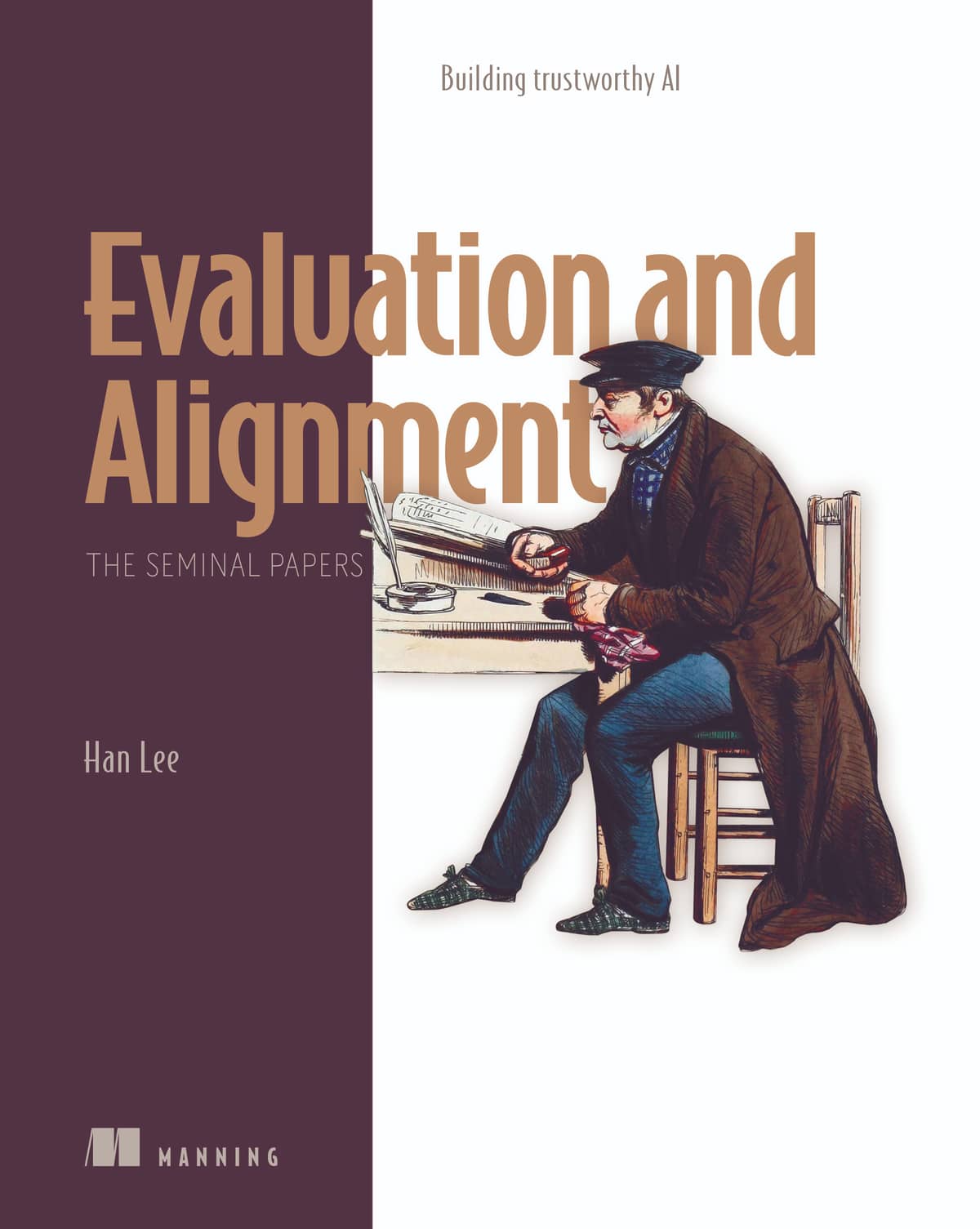
Erlang and OTP in Action teaches you the concepts of concurrent programming and the use of Evaluation and Alignment: The Seminal Papers teaches you to think of evaluation as a design constraint. You’ll employ a “working backwards” methodology that begins with what your system must get right, which directs you to the appropriate evaluation approach. As you internalize the define > evaluate > analysis > align cycle, you’ll start making more informed tradeoffs, and expertly balancing helpfulness, safety, and brand voice in your models.
Hanchung Lee
Evaluation and Alignment: The Seminal Papers brings together a set of influential research papers and connects them to day-to-day engineering work. The focus isn’t just on metrics in isolation, but on how evaluation shapes the system you end up building.
The book traces how evaluation has evolved. It starts with straightforward approaches like text matching, moves through semantic similarity, and reaches more recent methods where models are used to judge other models. Seeing that progression helps explain why certain techniques break down and where newer ones fit.
One idea that runs throughout the book is treating evaluation as a design constraint. Instead of measuring quality after the fact, you begin by defining what the system must get right. That choice influences everything else—what data you collect, which metrics you use, and how you interpret results.
There’s also a strong emphasis on closing the loop. Evaluation feeds analysis, which leads to changes in prompts, data, or architecture. Those changes get tested again. Over time, this cycle becomes part of how you build and maintain AI systems, not something you bolt on at the end.
Some of the topics covered along the way:
-
choosing evaluation methods that match the behavior you care about
-
spotting failure modes that simple metrics tend to miss
-
working with subjective qualities like helpfulness, safety, and tone
-
using evaluation results to guide alignment decisions
If you’ve worked on LLM-based systems, you’ve probably run into the gap between a model that “looks good in a demo” and one that holds up in production. This book is aimed squarely at that gap.
Don’t forget you can get 45% off with your Devtalk discount! Just use the coupon code “devtalk.com” at checkout 